REVIEW · SIEM REAP
2-Day Eight Temple Tour with Optional Sunrise
Book on Viator →Operated by Angkor Pura Tours · Bookable on Viator
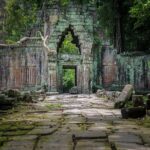
Two days can sound rushed, but this route keeps it workable. You’ll see a stack of famous names around Siem Reap, moving between classic Khmer architecture and the jungle-choked ruins that make Angkor so memorable.
What I like most is the private setup and the fact you can take breaks instead of getting stuck in a slow moving crowd line. I also like the private guide storytelling angle, since the carvings, towers, and layouts make far more sense when someone explains what you’re looking at.
The main thing to consider is the temple dress code: you need shoulders and knees covered, even on hot days.
In This Review
- Key Highlights to Know Before You Go
- Two Days, Eight Temples, One Easy Route in Siem Reap
- Private Guide Energy: What Makes the Tour Feel Worth It
- Day 1: Pre Rup’s Climb, Banteay Samre’s Similarity, and Banteay Srei’s Pink Sandstone
- Pre Rup: The “Mountain Temple” with the Rewarding View
- Banteay Samre: Khmer Architecture in a Familiar Style
- Banteay Srei: Pink Sandstone and the Legend of the Carvers
- Ta Prohm: Tomb Raider Temple, Jungle Included
- Banteay Kdei: Monks’ Cells and the Citadel of Chambers
- Day 2: Angkor Wat’s Scale, Preah Khan’s Untouched Feel, Bayon’s Mixed Inscriptions
- Angkor Wat: Start Early Energy for a Massive Icon
- Preah Khan: Jayavarman VII’s Temple Left to the Elements
- Bayon: Faces, Hindu Roots, and Buddhist Blend
- Timing, Sunrise Option, Heat, and Temple Dress Code
- Cost and Value: How the $98 Price Works With the Temple Pass
- What’s included in the price
- What’s not included
- Who This Tour Fits Best (And Who Might Want a Different Plan)
- Should You Book This 2-Day Eight Temple Tour?
- FAQ
- What temples are included on this two-day tour?
- How long is the tour?
- How much does the tour cost?
- Is food or drinks included?
- Is the temple pass included?
- What is included with the tour besides the temples?
- What about tickets and confirmation?
- Do I need to cover my shoulders and knees?
- Is this a private tour?
- What’s the cancellation policy?
Key Highlights to Know Before You Go
- Hotel pickup + private transport: You don’t waste your morning negotiating rides across Siem Reap.
- A story-led guide: Expect history and stories tied to each stop, not just temple photos.
- Pre Rup’s climb for big views: The effort pays off with a unique countryside panorama.
- Ta Prohm, the Tomb Raider temple vibe: The jungle intrusion is the whole point here.
- Angkor Wat at the start of Day 2: The itinerary is set up so you hit the centerpiece while you’re fresh.
- A choice of optional sunrise: If offered on your departure, it’s a chance to catch cooler light.
Two Days, Eight Temples, One Easy Route in Siem Reap
This is an eight-temple style tour designed for people who want variety without building a logistics spreadsheet. The area around Siem Reap is packed with ancient sites, but hopping between them on your own can mean long waits, missed timing, and more stress than sightseeing.
With a private group and transport arranged for you, you’re free to move at a human pace. The tour also includes cold water, which sounds simple until you’re walking under the sun and realizing hydration is not optional.
You’ll be hitting both the “big name” temples and the ones that feel more personal once you slow down. That balance is a big part of why this kind of tour works so well for first-timers.
You can also read our reviews of more tours and experiences in Siem Reap
Private Guide Energy: What Makes the Tour Feel Worth It
A private guide is the difference between seeing temples and understanding them. Here, your guide brings the “why” behind the shapes, locations, and stories. That matters because many details are not obvious at a distance.
One review specifically called out the guide named Sam as a master storyteller with serious photography skills. Even if your guide isn’t Sam, the payoff you should expect is similar: less guesswork, more context, and better use of your time on site.
You also get more control over pacing. The tour promises no crowd bottlenecks holding you up, which is exactly what you want in Angkor-area circuits. It’s not about avoiding people entirely, but about not being dragged along at someone else’s schedule.
Day 1: Pre Rup’s Climb, Banteay Samre’s Similarity, and Banteay Srei’s Pink Sandstone
Day 1 is where the tour leans into variety—views, carvings, and jungle drama. The stops are close enough to keep the day feeling smooth, but spaced enough that each temple has its own moment.
Pre Rup: The “Mountain Temple” with the Rewarding View
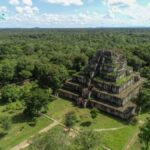
Pre Rup is known as a mountain temple because you climb up to reach the towers at the top. It’s steep enough to feel like a real workout, not a scenic stroll.
The payoff is the reason people push upward: you get a unique view of the countryside around Siem Reap. From up there, the scale of the area clicks. You stop thinking of Angkor as a single complex and start seeing it as part of a wider historical landscape.
One practical tip: go at your own pace on the climb. Wear shoes with grip, and plan to pause briefly on the way up so you can enjoy the top without arriving totally drained.
Banteay Samre: Khmer Architecture in a Familiar Style
Next comes Banteay Samre, described as a stunning example of Khmer architecture built in a style similar to Angkor Wat. If Angkor Wat feels overwhelming, this is a gentler entry point that still gives you those Khmer-era design cues.
You can easily spend about an hour here, especially if you like examining towers and the intricate carvings. The value of this stop is that it helps you spot recurring Khmer motifs before the day pivots into more famous ruins.
You can also read our reviews of more tours and experiences in Siem Reap
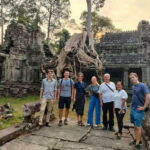
Banteay Srei: Pink Sandstone and the Legend of the Carvers
Then you’ll hit Banteay Srei, often remembered for its pink sandstone, quarried from the Kulen Mountain range. Visually, it’s a big shift from the stone tones you might be expecting in the Angkor region.
The carvings are a major draw here. There’s also a legend attached to the workmanship—that the carvings were carved by women. The tour frames it as a story rather than a confirmed fact, but it adds a human layer to what you see in the stone.
If you care about details, this is one of the stops where slowing down pays off. Expect to spend time looking closely rather than just walking through.
Ta Prohm: Tomb Raider Temple, Jungle Included
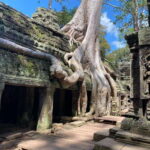
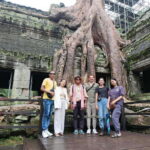
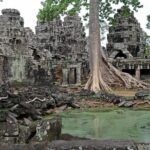
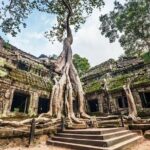
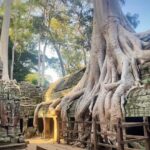
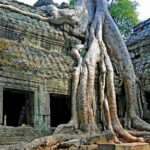
After Banteay Srei, the itinerary takes a dramatic turn to Ta Prohm, nicknamed the Tomb Raider temple. This is the one you’ll recognize fast because the jungle has grown into the ruin, and the building feels like it’s being reclaimed.
Ta Prohm was used as a set for the Tomb Raider movie starring Angelina Jolie, and the connection helps explain why it draws so many people. But the real reason it works is simpler: this temple was left to the elements, so nature and stone are co-authors of the scene.
The layout can feel like you’re walking through a maze of roots and doorways. Wear sturdy footwear, keep an eye on uneven ground, and don’t rush. Photos are great, but Ta Prohm is best when you take the time to look from multiple angles.
Banteay Kdei: Monks’ Cells and the Citadel of Chambers
To close Day 1, you’ll visit Banteay Kdei, known as the Citadel of Chambers or the Citadel of Monks’ Cells. It’s located nearby Ta Prohm, which helps keep the day from getting chaotic.
This Buddhist temple adds another religious layer to what you’ve already seen. If Day 1 felt like architecture plus atmosphere, Banteay Kdei rounds out the day with a calmer, more contemplative feel.
Day 2: Angkor Wat’s Scale, Preah Khan’s Untouched Feel, Bayon’s Mixed Inscriptions
Day 2 focuses on the heart of the Angkor Archaeological Park, with three heavy-hitters. The order matters: you start with the centerpiece while you’re still fresh enough to appreciate it.
Angkor Wat: Start Early Energy for a Massive Icon
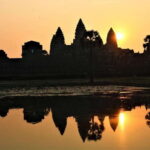
Angkor Wat is the reason most people come to Siem Reap. It attracts over 2 million visitors per year and is the largest temple built during the Khmer empire.
You’re not just seeing a pretty temple; you’re seeing scale and planning. Angkor Wat’s layout makes you think in geometry and symbolism, even if you don’t read inscriptions. A guide helps you connect the dots: what you’re looking at, what it likely meant, and how the temple fits into the broader park.
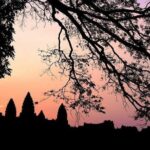
If you have the optional sunrise on your schedule, this kind of start is where that cooler light can be most valuable. Even without sunrise, arriving when the site is operating smoothly helps you avoid the worst bottlenecks.
Preah Khan: Jayavarman VII’s Temple Left to the Elements
Next is Preah Khan, built in the 12th century by King Jayavarman VII. One of the defining details is that it has been left to the elements. It’s made safe for visitors, but very little restoration work has taken place.
That means you’ll likely see more raw ruin texture and less “polished” stonework than at places with heavier restoration. For many people, that’s a win. It can feel more honest and more connected to the actual age of the site.
If you like exploring without everything looking rebuilt, Preah Khan is a great stop. Just go slow, watch your footing, and give yourself permission to wander a bit.
Bayon: Faces, Hindu Roots, and Buddhist Blend
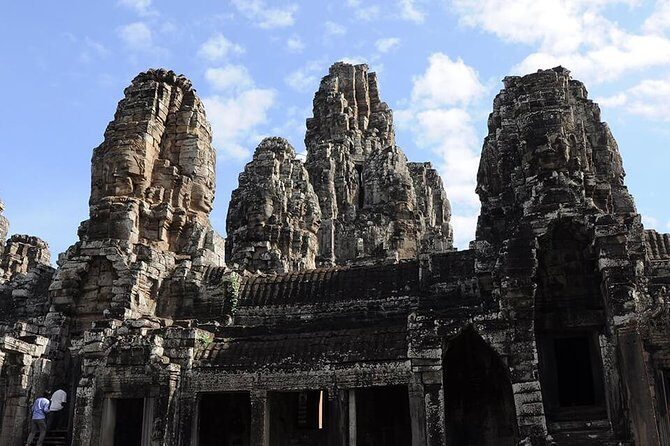
Finally, you’ll reach Bayon, described as majestic and a favorite for many visitors. Bayon is a fascinating blend: remnants of Hindu inscriptions plus both Mahayana and Theravada Buddhist inscriptions.
That mixture is part of what makes Bayon more than a single-style temple. It reflects how belief systems and eras overlapped in Angkor’s long history. When your guide points out what you’re seeing, the temple shifts from decoration to a layered record of time.
Plan to spend a few hours here. The temple has nooks and crannies, and it’s easy to miss details if you only do a quick circuit.
Timing, Sunrise Option, Heat, and Temple Dress Code
A two-day temple loop is mostly a pacing game: walking, waiting, and staying comfortable enough to actually look.
You’ll want to take the dress code seriously. Temples require shoulders and knees covered, and you don’t want to be searching for a solution in the middle of the day. Bring lightweight layers you can quickly adjust if it’s windy or you get warm.
The tour also includes cold water, which helps you keep going between sites. You’ll still want to manage your own pace, especially during the climb at Pre Rup and the walking between areas.
About the optional sunrise: your title mentions it, so it’s worth asking whether it’s included at booking or offered as an add-on on your departure. If you do sunrise, you’ll likely get cooler temperatures and softer light, but you’ll also trade sleep. Either way, it’s a personal call.
Cost and Value: How the $98 Price Works With the Temple Pass
At $98 for about two days, this tour is positioned as a budget-friendly way to pack in major temples without doing your own transport planning. The big question is what’s included versus what you’ll need to pay separately.
What’s included in the price
You get a tour guide, cold water, and suitable transport for your group size. You also get convenient pickup from your Siem Reap hotel, plus the tour uses a mobile ticket.
For a temple circuit, having transport and a guide lined up is where most of the value shows. It cuts down on guesswork, time loss, and the friction of going temple to temple alone.
What’s not included
Food and drinks, accommodation, and personal expenses are not included. Most importantly, the tour requires the 3-day temple pass, listed at $62 per person.
So the realistic budget for temples is more like $98 + $62 per person. That’s still often a fair deal when you’re paying for a guide and private transport across multiple sites—but it’s smart to plan for the pass so there are no surprise calculations later.
Who This Tour Fits Best (And Who Might Want a Different Plan)
This tour fits best if you want to see a lot of Angkor-area temples but don’t want to manage routes, timing, and transport day after day.
You’ll probably enjoy it if:
- you like a mix of famous temples and more detailed stops where you can take your time
- you want context from a guide, not just a list of monuments
- you value private pacing, meaning fewer forced slowdowns
You might want to consider a different approach if:
- you’re only interested in one or two superstar temples and don’t want to cover multiple sites
- you strongly dislike walking and climbing, since Pre Rup involves a steep climb to reach the top
Should You Book This 2-Day Eight Temple Tour?
Yes, if you want an organized route that still leaves space to look closely. The standout value here is the combination of private transport, pickup, and a guide who tells the story behind what you’re seeing.
Pay attention to the practical stuff: bring the right clothing for temple entry, expect a lot of walking, and budget for the 3-day temple pass. If those pieces fit your travel style, this tour is a smart way to spend two days in Siem Reap and feel like you truly touched multiple parts of the Angkor universe—not just the front gate.
FAQ
What temples are included on this two-day tour?
The itinerary includes Pre Rup, Banteay Samre, Banteay Srei, Ta Prohm, Banteay Kdei, Angkor Wat, Preah Khan, and Bayon.
How long is the tour?
It runs for about 2 days.
How much does the tour cost?
The price listed is $98.
Is food or drinks included?
No. Food and drinks are not included.
Is the temple pass included?
No. The 3-day temple pass is not included and is listed as $62 per person.
What is included with the tour besides the temples?
The tour includes a guide, cold water, and suitable transport for the group size, plus convenient hotel pickup in Siem Reap.
What about tickets and confirmation?
Confirmation is received at booking, and the tour uses a mobile ticket.
Do I need to cover my shoulders and knees?
Yes. Guests must cover their shoulders and knees to enter the temples.
Is this a private tour?
Yes. Only your group will participate.
What’s the cancellation policy?
Free cancellation is offered up to 24 hours in advance for a full refund. If you cancel less than 24 hours before the start time, the amount paid is not refunded.