REVIEW · SIEM REAP
Siem Reap Angkor Private Tour Guide in English and Spanish
Book on Viator →Operated by Angkor wat guía en español · Bookable on Viator
Angkor temples feel bigger than life at sunrise. This private tour lines up Angkor Wat, Bayon, and Ta Prohm with a guide who brings real research context to what you see.
I really like two things right away: you get a true private guide (so you can ask questions as you go), and you start early from Siem Reap with pickup and cold water for the long day.
One consideration: temple admission fees are not included, so you’ll want to budget for entry tickets before you arrive at the gates.
In This Review
- Key highlights worth caring about
- Morning Start in Siem Reap: 5:00 am is more than a time on paper
- Angkor Wat first: moat views and that 700-metre bridge experience
- Bayon Temple with the smiling faces: 54 towers and three levels to read
- A second Angkor Wat chapter: the ancient city, the million people, and the decline story
- Ta Prohm like it was found: roots, big trees, and the 19th-century discovery feel
- Price and what you’re really paying for (including the temple ticket math)
- Private guide value: Son’s Spanish plus research-level context
- Who this tour fits best in real life
- Should you book this private Angkor guide?
- FAQ
- What is included in the $65 price?
- Do I need to pay temple entrance fees?
- Is there anything else I might need to budget for?
- How long is the tour?
- Where does the tour start, and what time?
- Is this a private tour and is pickup offered?
- What is the cancellation policy?
Key highlights worth caring about
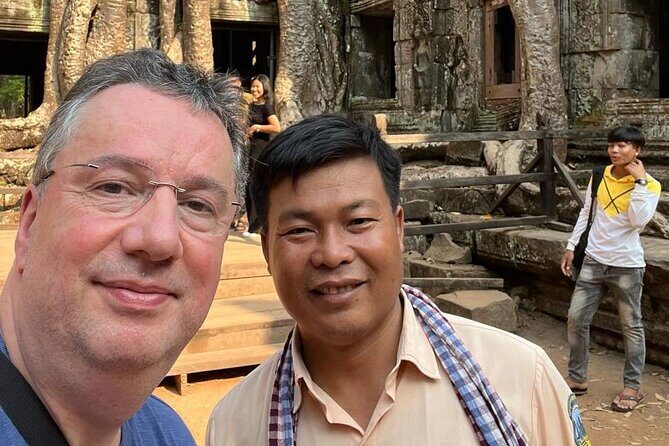
- Son, the Spanish-speaking guide, is praised for clear answers about temples and Cambodian culture
- University of Sydney Greater Angkor Project research background helps explain dams, canals, and the decline story in plain language
- An early 5:00 am start gives you temple time before the day gets hot and crowded
- Specific “must-see” temple structure: Angkor Wat’s long bridge, Bayon’s 54 towers, Ta Prohm with living roots
- Private transportation + mobile ticket keeps things smooth when you’re moving between sites
Morning Start in Siem Reap: 5:00 am is more than a time on paper
This tour is built around a very practical idea: start early, move efficiently, and spend your energy where it matters—at the temples. The meeting point is at Hard Rock Cafe Angkor on King’s Road (Old Market Bridge area), and the tour starts at 5:00 am.
You’ll get private transportation, so you’re not playing the typical “find the right driver, negotiate the price, hope your timing works” game. Cold water is also included, which sounds small until you’re walking in full daylight. You’re likely to feel the difference between an early start and a late one when you’re trying to stay sharp for details like carvings, skyline angles, and how each temple sits in its surrounding walls and moats.
Another quiet win: because it’s private, your guide can pace you. If you want more time at a viewpoint, you can usually make it happen without turning it into a group committee decision.
You can also read our reviews of more guided tours in Siem Reap
Angkor Wat first: moat views and that 700-metre bridge experience

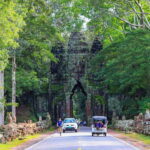
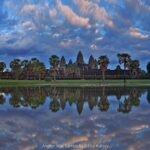
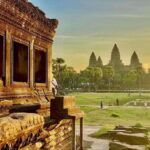
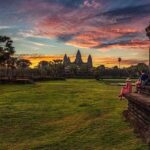
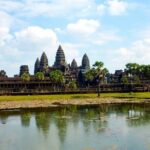
Angkor Wat is the headline for a reason. It’s a vast temple complex north of Siem Reap, wrapped in a surrounding moat, and you’ll be treated to one of the classic approaches: crossing the 700-metre bridge for a strong first sightline.
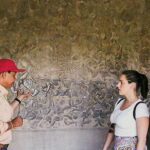
You’ll spend about 3 hours here. That length matters. A rushed visit turns Angkor Wat into quick snapshots. More time lets you actually notice how the layout guides your eye—symmetry, levels, and the way the temple pulls you toward the center. And with a guide like Son, the carvings and layout aren’t just decoration. He’s experienced at answering questions about what you’re seeing and how Khmer people understood sacred space.
If you’re the type who likes to connect art to engineering, this is also where the guide’s research background becomes useful. The information you get about water systems—like dams and canals—can help you understand why Angkor didn’t just rely on monuments. It relied on systems that supported a large population.
Drawback to flag: entrance fees for temple access are not included. So make sure you have the budget and plan for tickets before you reach the gates.
Bayon Temple with the smiling faces: 54 towers and three levels to read

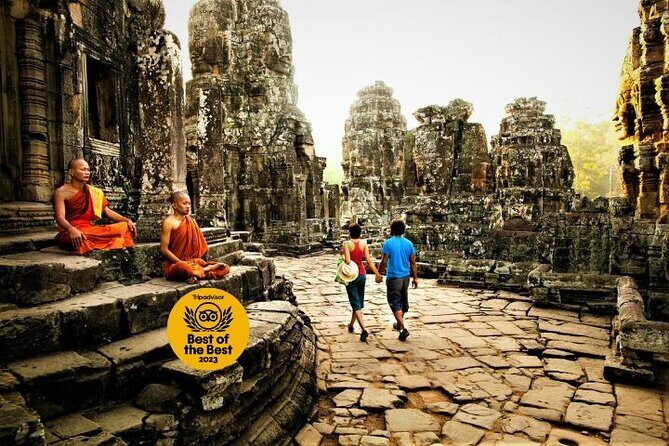
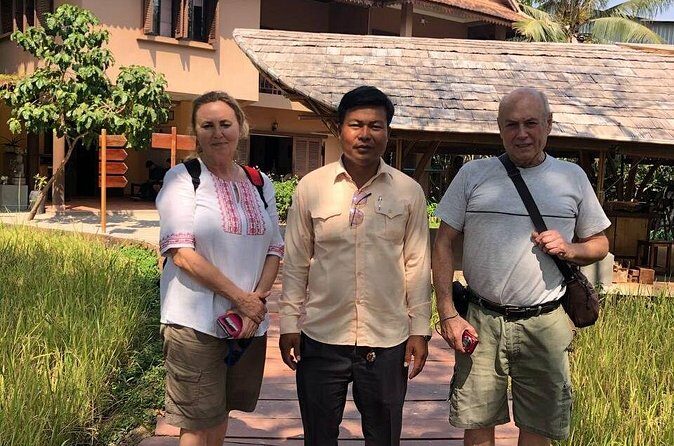
Next up is Bayon Temple, often described as the smiling faces temple, and for once that nickname isn’t just marketing fluff. Bayon is built in three levels and includes 54 towers, each one topped with those famous faces.
This stop is shorter—about 1 hour—but it’s still a good use of time because Bayon rewards movement. You’ll want to shift positions to see how the faces look from different angles and distances, especially as you move between levels and corridors.
Where this becomes more meaningful is through explanation. A strong guide helps you see Bayon as part of the larger Angkor story rather than a standalone photo spot. With Son, you can ask questions and get answers that connect the temple’s design to broader cultural context, not just dates and names.
If you’re sensitive to crowds, Bayon can still get busy. Going early helps, but even within a single day, the mood can change. Think of this as a place to slow down briefly, then keep moving so you don’t lose your momentum for the rest of the circuit.
A second Angkor Wat chapter: the ancient city, the million people, and the decline story
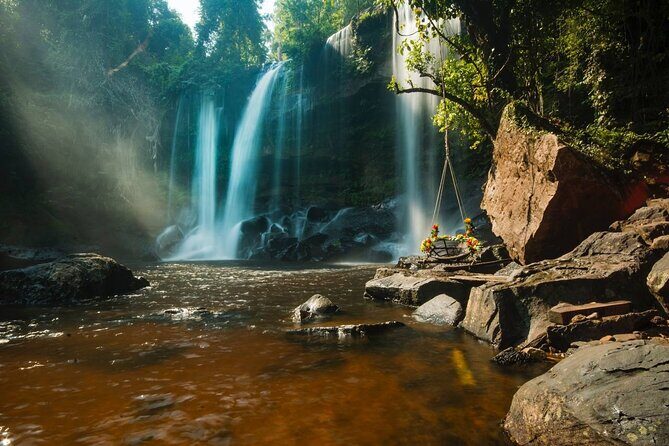
After Bayon, you’ll head back into the Angkor area with time framed around a bigger idea: Angkor as a living city, not just a set of temples. You’ll get about 2 hours focused on the ancient city concept—described here as a place that was populated for many generations, with an estimate of around one million people, active from the 9th to 14th century.
This is where the University of Sydney research connection is especially relevant. Angkor didn’t disappear because the stones ran out. The guide’s expertise includes archaeology-style thinking about why major systems declined—like how water management and settlement patterns shifted over time. When you understand that angle, the jungle parts of the site feel less like “random nature intrusion” and more like the result of a civilization changing its ability to sustain itself.
I like this chunk of the tour because it gives you a framework. After you’ve heard the decline context, you’ll start reading the temples differently: you’ll notice what looks preserved, what looks reclaimed, and what signals abandonment rather than constant use.
Important note: like the other stops, entrance fees for temple access are not included. So plan for that cost if you’re counting total spend.
Ta Prohm like it was found: roots, big trees, and the 19th-century discovery feel
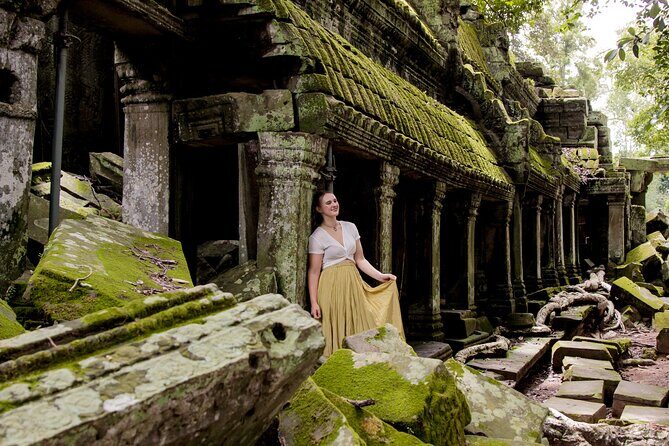
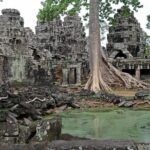
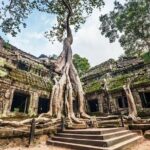
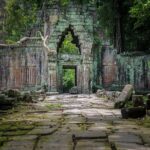
Ta Prohm is one of the most striking places in the Angkor complex because nature and stone share the same frame. The tour includes about 1 hour here, and the key idea is the way Ta Prohm looks like a snapshot from the moment the city was rediscovered in the 19th century.
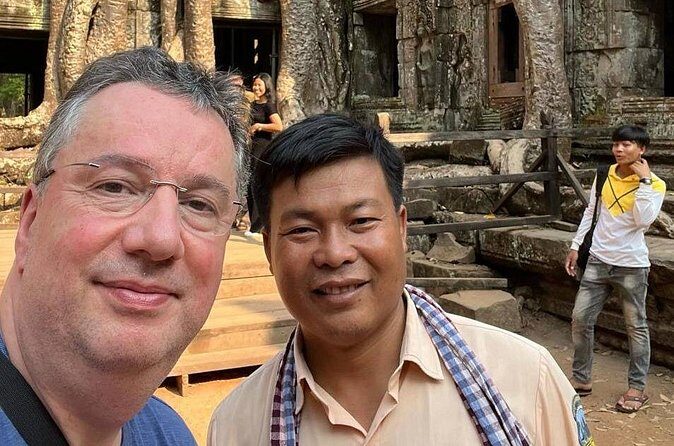
This stop is described as a model of how the site looked when it was found: lots of vegetation, large trees, and enormous roots that are still growing on the structures. That’s the practical reason Ta Prohm can be so memorable—you’re walking through a temple scene where scale is obvious. Roots aren’t tiny decorative details; they’re structural elements you can’t ignore once you see them up close.
With a private guide, you can also get better at pacing your photos and walking paths. If you want to spend time at specific viewpoints or step into quieter corners, you can do it without dragging the group behind you. Son’s strength, according to the praise you’ve got to go on, is that he answers questions about temples and Cambodian culture—so if Ta Prohm’s look raises questions for you, you’ll have a guide ready to help.
One more practical thought: Ta Prohm can involve uneven ground and thick roots. Wear shoes you trust.
You can also read our reviews of more private tours in Siem Reap
Price and what you’re really paying for (including the temple ticket math)
The base price is $65 per person for a private tour that runs about 5 to 7 hours (depending on timing, pacing, and how the day unfolds). Included are private transportation, cold water, and a private tour guide.
Here’s the value math that matters: the $65 covers the human expertise and logistics. It does not cover most of the temple entry fees. Temple admission is listed as $37 for 1 day or $50 for 3 days. There’s also an Angkor National Museum entrance fee listed at $15 per person, and a boat ticket entrance fee listed at $20 per person (not included).
So the true cost depends on what you choose beyond the core stops. If you want the most straightforward budgeting, assume you’ll pay for temple entry during the day and consider whether you also want museum time or any boat-related add-ons.
One more practical value point: you get a mobile ticket option and pickup, which reduces friction. In a place like Angkor, that matters because delays pile up fast when you’re juggling transport, tickets, and meeting points.
Private guide value: Son’s Spanish plus research-level context
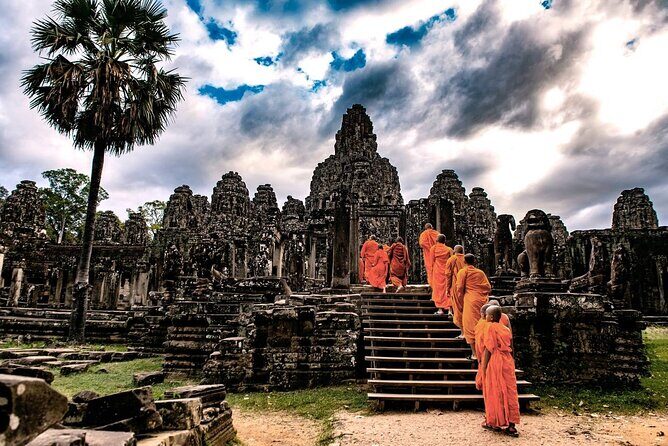
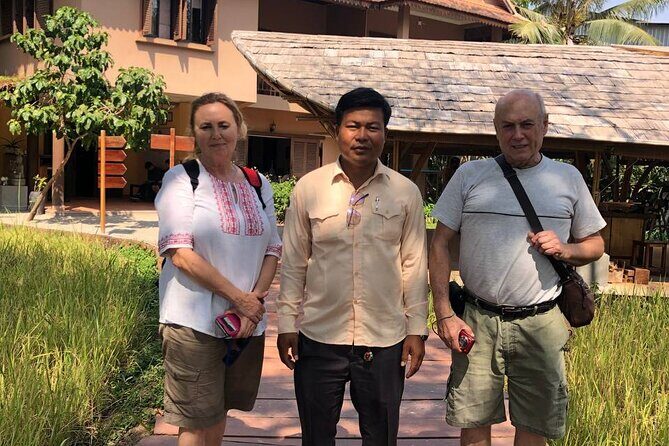
This is where the tour earns its reputation. The guide is presented as an experienced tourism professional, and the standout detail is his involvement with the Greater Angkor Project by the University of Sydney, tied to research about the decline of Angkor civilization and archaeological work involving dams, canals, and lost temples in jungle areas.
That matters because it changes how you experience the sites. Instead of hearing only surface-level facts, you’re getting explanations that connect engineering, environment, and human choices. You’ll still enjoy the temples as art and architecture, but you’ll also understand why water systems and settlement patterns were central to Angkor’s rise—and why decline played out over time.
The reviews specifically call out Son’s Spanish. People describe his Spanish as excellent and his answers as clear and thorough, including questions about both temples and Cambodian culture. If you’re traveling in Spanish, that’s a real quality-of-life upgrade. If you speak English, the tour is offered in English too, but Spanish seems to be an especially strong point.
If you like to ask why something is shaped a certain way, or you want help connecting what you see to what you’ve read, this guide setup is a strong match.
Who this tour fits best in real life
You’ll likely love this tour if you want:
- A private Angkor day with English or Spanish guidance
- Clear explanations that go beyond dates and names
- Efficient routing between Angkor Wat, Bayon, and Ta Prohm
- Flexibility to ask questions without feeling rushed
This tour may be less ideal if you only want a very quick hit list of photo spots and don’t care about context. In that case, you might prefer a cheaper group option and accept the trade-off: less time for questions and fewer chances to slow down for details.
Also, because the tour starts at 5:00 am, it suits travelers who can wake up early. If early mornings feel like punishment, you’ll want to weigh whether you’d rather trade context for a later start.
Should you book this private Angkor guide?
If you want an Angkor day that feels guided by understanding—not just walking from temple to temple—this is a strong choice. The combination of private transportation, a guide with deep Angkor research background, and a Spanish-speaking guide praised for answering questions well makes it feel like you’re getting more than admission access. You’re getting meaning.
Book it if your priority is a thoughtful, question-friendly tour and you’re comfortable budgeting for temple entry fees on top of the $65 base price. Skip it only if you want a super lightweight visit and don’t care about context.
FAQ
What is included in the $65 price?
The tour price includes private transportation, cold water, and a private tour guide.
Do I need to pay temple entrance fees?
Yes. Entrance fees for the temples are not included. Temple access is listed as $37 for 1 day or $50 for 3 days.
Is there anything else I might need to budget for?
The Angkor National Museum entrance fee is listed at $15 per person, and an entrance fee of a boat ticket is listed at $20 per person. These are not included in the tour price.
How long is the tour?
The tour runs about 5 to 7 hours (approximately).
Where does the tour start, and what time?
The tour starts at Hard Rock Cafe Angkor on King’s Road Angkor, near Old Market Bridge. Start time is 5:00 am.
Is this a private tour and is pickup offered?
Yes. It’s private, so only your group participates, and pickup is offered.
What is the cancellation policy?
You can cancel for free. You must cancel at least 24 hours before the experience’s start time for a full refund. If you cancel less than 24 hours before, you won’t get a refund.