Phnom Penh makes sense fast here. This guided heritage route pairs a digital tablet and headphones with short video stories, so you’re not just looking at buildings—you’re getting context as you move. I like that you see major sights in a tight 2 hours 30 minutes with 10-language audio, and I also like that the guide, Oliver, keeps things friendly and practical while you ask questions along the way.
One thing to note: several of the biggest landmarks are viewed from the outside, and some interiors are only possible when they’re open. Wat Phnom’s hill temple isn’t included, and the National Museum and Royal Palace aren’t part of the stop-by-stop visit, so you’ll likely want follow-up time if those are on your must-see list.
In This Review
- Key highlights you’ll actually feel on the ground
- A 2.5-hour orientation you can build on
- How the $24.36 ticket pays off in a short time
- Tablet storytelling: videos, vintage photos, and virtual access
- The French-era sweep: Post Office to governor-style buildings
- Stop 1: Phnom Penh overview
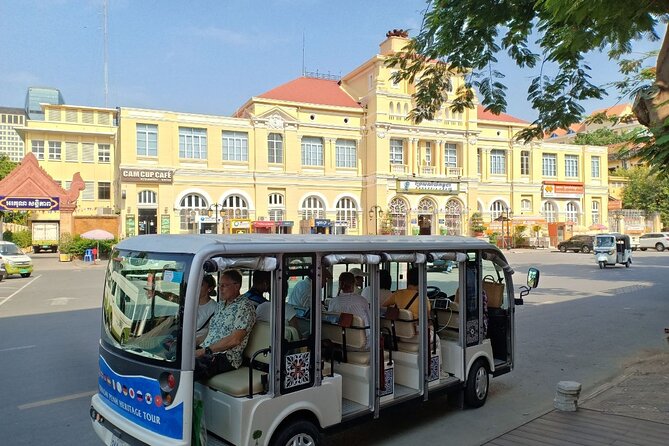
- Stops 2–3: Cambodia Post Office and Palais de la Poste
- Stop 4: Le Manolis (early hotel vibe)
- Stop 5: Commissariat of Phnom Penh Municipal Police
- Stop 6: Council for the Development of Cambodia (former governor’s house)
- Stop 7: Chinese house and Hokkien Temple (關帝古廟 / 民生中學)
- Stop 8: Naeggas Bridge
- From Wat Phnom to Street 240: markets, hotels, universities, and limits
- Stop 9: Wat Phnom (photos yes, hill temple not included)
- Stop 10-ish: The country club where the US Embassy is now
- Stop 10: The National Library (inside if open)
- Stop 11: Raffles Hotel Le Royal
- Stop 12: Railway Station (train station area)
- Stop 13: Hyatt Regency Phnom Penh (No Problem Villa)
- Stop 14: Royal University of Fine Arts (longer visit, often with students)
- Stop 15: National Museum (not included)
- Stop 16: FCC Phnom Penh (mansion under renovation, 2024/2025)
- Stop 17: UNESCO Cambodia
- Stop 18: Royal Palace (view only, not included)
- Stop 19: British Ambassador’s residence (Street 240) and the epilogue
- What themes you’ll pick up (and how to use them later)
- Timing tips: do this early, then choose your next steps
- Who this tour is best for
- Should you book Phnom Penh Heritage Tour?
- FAQ
- How long is the Phnom Penh Heritage Tour?
- What’s included with the ticket?
- Is the tour ticket mobile?
- How many stops are there, and what kind of sites do you visit?
- Are any major attractions included as full visits?
- Where does the tour start and end?
- How big is the group?
Key highlights you’ll actually feel on the ground
- Tablet + headphones, 10 languages: audio stays synced with the stops, not a long lecture.
- French-era and Art Deco themes: you get the why behind what you’re seeing, especially around the Post Office and older institutional buildings.
- Up to 10 people: small-group pace makes it easier to hear and ask Oliver questions.
- Photo limits at the US Embassy-area country club: you’ll know where you can’t shoot photos.
- Inside options when open: you may be able to go into the old Indochina Bank, the Hokkien Temple, the National Library, and the Royal University of Fine Arts.
- End point near the Royal Palace zone (Street 240): you finish where you’re likely headed next.
A 2.5-hour orientation you can build on
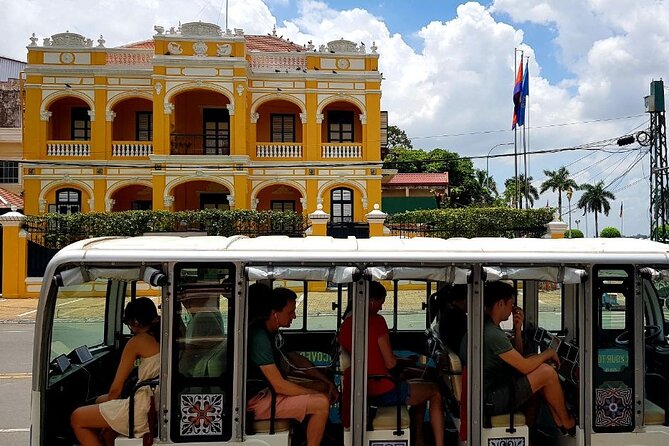
If Phnom Penh feels confusing when you first arrive, this tour is designed to fix that quickly. You start near Street 13 and Street 102, then ride through the city to hit 22 major sites tied to the French protectorate era and the following decades that shaped the capital. The pace is brisk, but it doesn’t feel like you’re getting steamrolled—most stops include video segments on the tablet, plus time to look around and take pictures.
The smart move here is that the tour doesn’t treat each building as a random photo stop. It ties the sights together through themes: how Phnom Penh became an urban capital, the first planning on a French model, the social structure of the elite at the start of the 1900s, and the darker Khmer Rouge period. Even if you only remember a few details, that’s enough to make the rest of your day click.
How the $24.36 ticket pays off in a short time
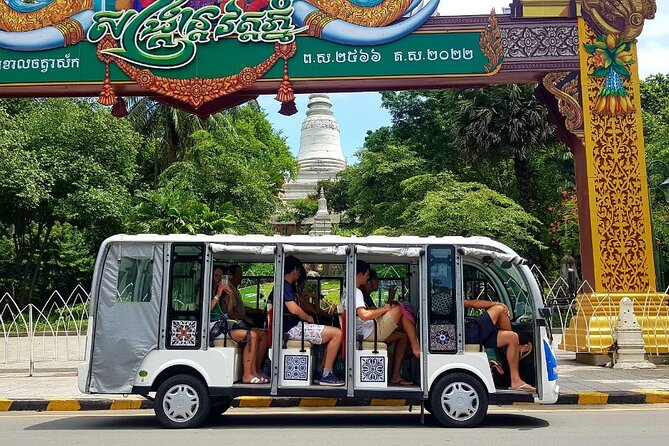
At $24.36 per person for roughly 2 hours 30 minutes, you’re paying for three things: guidance, audio, and time efficiency. The tour also includes bottled water and a staff-led setup with headphones, so you’re not stuck figuring out where to stand or what to listen for.
A practical note: private transportation isn’t included. In other words, you’re joining the tour’s shared transport and group flow rather than hiring a car for yourself. Plan on arriving at the meeting corner (Street 102 & Street 13) a few minutes early so you can get settled before the first stop.
You’ll also end at Oknha Chhun St. (Street 240) near the Royal Palace and Wat Botum Square. That finish point is helpful because it puts you in the thick of things for anyone planning an afternoon or evening around the palace area.
Tablet storytelling: videos, vintage photos, and virtual access
What makes this tour different from the usual “walk-and-point” style is the tablet format. You get a digital tablet with audiovisual guides plus headphones, in 10 languages. The videos use films, vintage photos, and historical anecdotes to explain what you’re seeing right then and why it matters.
You’ll also notice a “virtual visit” element. The tour can let you virtually enter certain buildings that aren’t open to the public. That matters in Phnom Penh because several important structures are either restricted, under repair, or simply not made for casual wandering. The tablet helps you connect the dots even when you can’t get inside.
And Oliver’s role is real, not performative. At at least one key stop—the Cambodia Post Office—he’s positioned as someone you can talk to. That helps when you want clarity on what a place used to be, what it is now, or what you should do after the tour.
The French-era sweep: Post Office to governor-style buildings
Your first big theme is how French colonial influence shaped the capital’s institutional core. Stops early on focus on buildings that still feel like they belong to a different era—formal facades, older bank-style architecture, and structures that once housed power and services.
Stop 1: Phnom Penh overview
You begin with a context-setting start at Phnom Penh itself. It’s a quick orientation, like getting the map legend before you start reading street names.
Stops 2–3: Cambodia Post Office and Palais de la Poste
These are major anchors of the route. You’ll stop at the Cambodia Post Office for a guided audio sequence with multiple audiovisual segments, and the tour continues at Palais de la Poste, described as the old Indochina Bank area. This is where you’ll start noticing the visual language of the period: institutional seriousness, designed entrances, and architecture meant to last.
If you like historical photos becoming real buildings in front of you, this section is made for that. The audio format helps you see what was there before, even as you stand in today’s Phnom Penh.
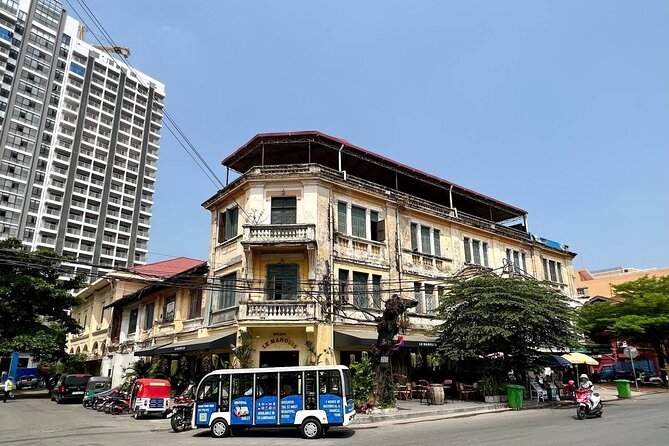
Stop 4: Le Manolis (early hotel vibe)
Le Manolis is your step into the lifestyle side of the story—how visitors and the early elite moved through the city. The audio guide here frames it as one of the first hotels in Phnom Penh, which gives the architecture and setting a social meaning, not just a facade.
Stop 5: Commissariat of Phnom Penh Municipal Police
This stop gives you the governance-and-control angle. It’s described as the old police station, and the audio helps you understand how order and administration were organized in the capital during that earlier period.
Stop 6: Council for the Development of Cambodia (former governor’s house)
Now you’re looking at a different kind of authority: the governor-style seat, framed by the audio as the old governor’s house. It’s a useful contrast to the police-station stop because it shows you how power sat in different kinds of buildings.
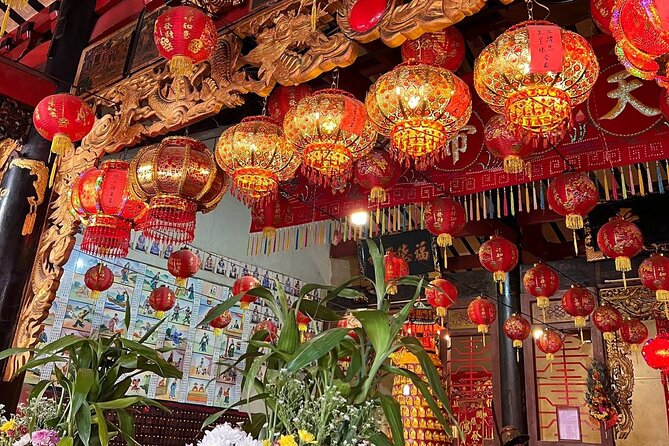
Stop 7: Chinese house and Hokkien Temple (關帝古廟 / 民生中學)
This stop shifts the cultural mix. You’ll see the Chinese house and the Hokkien Temple, connected through the audio guides. There’s also a longer audio segment here (multiple guides) and a possibility to visit inside some places if conditions are right.
This is a good reminder that Phnom Penh’s story isn’t only French. Trade communities and temple networks were—and still are—part of the city’s identity.
Stop 8: Naeggas Bridge
You’ll hear about the old naga bridge, which adds a myth-and-legend layer to what’s otherwise a fairly institutional route. Even a short stop like this can be satisfying because it breaks the pattern of “buildings that ran systems” and adds a story people still recognize.
From Wat Phnom to Street 240: markets, hotels, universities, and limits
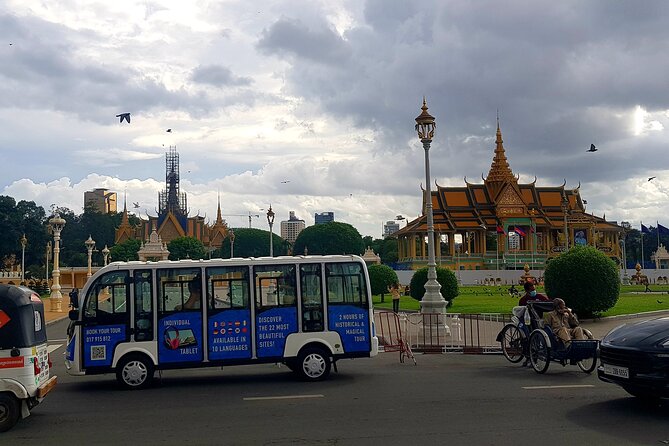
After the French-era core, the tour expands into the city’s broader public-life spaces and the royal-adjacent zone—while being clear about what’s included and what’s not.
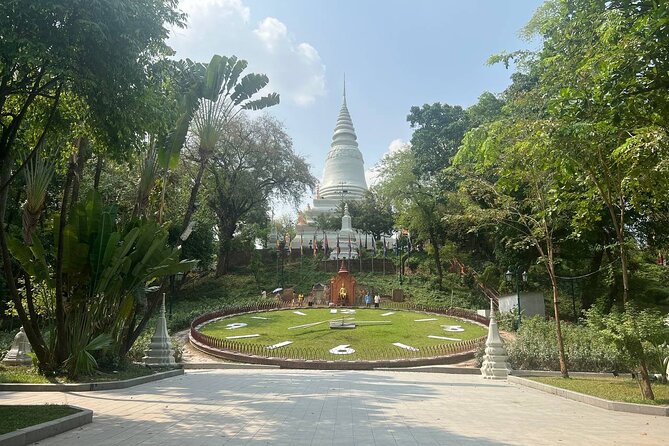
Stop 9: Wat Phnom (photos yes, hill temple not included)
At Wat Phnom, you can take pictures, but the tour notes that the actual temple visit on the hill isn’t included. So treat this as a look-from-outside and an orientation moment, not the final climb.
Stop 10-ish: The country club where the US Embassy is now
This is one of the more “real life” constraints on the route. The audio guide covers the country club area that is where the US Embassy is today, and pictures aren’t allowed. It’s a good stop to learn how these spaces changed hands over time, but it’s also a reminder to follow photo rules immediately.
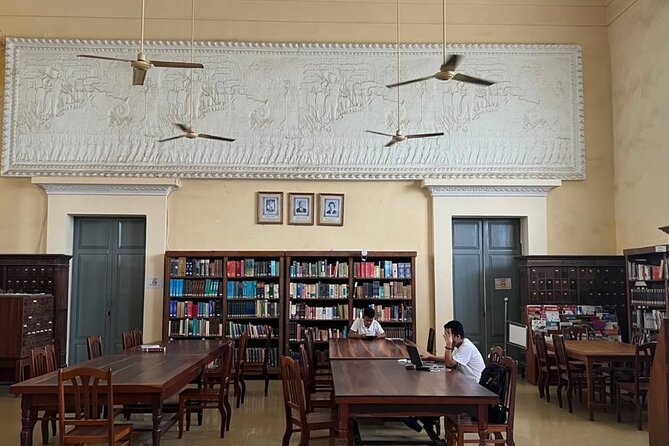
Stop 10: The National Library (inside if open)
Next is the National Library. The tour says you might be able to visit inside if it’s open. Even if you don’t get inside, the outside stop fits the overall pattern: institutions that represent education and official knowledge.
Stop 11: Raffles Hotel Le Royal
You’ll get a short, focused segment about Raffles Hotel Le Royal, described as probably the best hotel in Cambodia. It’s a quick look, but it supports the larger theme: the early-1900s lifestyle of the elite and how grand hospitality fit into the capital’s identity.
Stop 12: Railway Station (train station area)
This stop turns the city’s movement system into a historical clue. The audio guide ties the stop to the train station story, helping you understand Phnom Penh as a place built for travel and connection, not only administration.
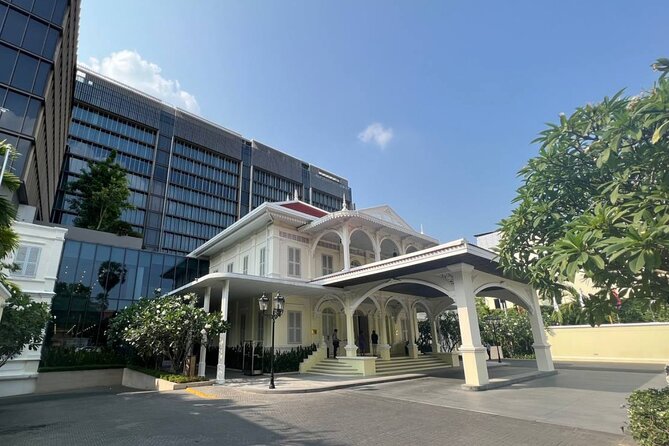
Stop 13: Hyatt Regency Phnom Penh (No Problem Villa)
The tour frames this area as the old No Problem Villa. It’s another lifestyle marker in the city’s layered timeline, and it’s especially useful if you want to connect architecture to modern-day Phnom Penh landmarks.
Stop 14: Royal University of Fine Arts (longer visit, often with students)
This is one of the standout portions because it’s not just a viewpoint stop. The audio guide includes a guided visit and talks about the Royal University of Fine Arts, and the tour indicates that most of the time you can see students practicing their art. Even if you only catch a moment, it adds a living layer to the history you’ve been hearing.
Stop 15: National Museum (not included)
The tour covers the National Museum with audio, but the actual museum visit isn’t included. Plan your own time if you want artifacts and galleries, because this tour gives you context, not the full museum experience.
Stop 16: FCC Phnom Penh (mansion under renovation, 2024/2025)
You’ll stop at FCC Phnom Penh for an audio segment about the old mansion. It’s described as under renovation and under cover for 2024/2025, so views may be limited. Still, the stop works because it explains the building’s identity even when the facade looks like a construction site.
Stop 17: UNESCO Cambodia
This is a short “now” marker. The audio guide frames it as the UNESCO house, which helps you connect the historic city to the current international presence.
Stop 18: Royal Palace (view only, not included)
The Royal Palace is introduced with audio, but the visit itself isn’t included. You still get a look and the historical framing, then you end your tour nearby—so the palace becomes an easy add-on after the guided portion.
Stop 19: British Ambassador’s residence (Street 240) and the epilogue
The final stop is the Residence of the British Ambassador to Cambodia on Street 240. The audio guide includes an epilogue, and you finish here—again, a helpful location if you’re heading into the palace area or continuing on your own.
What themes you’ll pick up (and how to use them later)
This tour is built around a set of big stories, and those themes help you travel smarter after the bus drops you off.
French protectorate-era planning matters because it explains why so many buildings look like European institutions even when you’re standing in Southeast Asia. Once you understand that, you start seeing “urban design” patterns rather than just individual landmarks.
Art Deco architecture comes up as a trend during the period when Phnom Penh’s city identity shifted. Even when you can’t quote exact styles, the audio helps you notice details like proportions and facade behavior—what looks “formal,” what looks “designed for display,” and what looks like it was built for public-facing authority.
And then there’s the emotional weight: the audio discusses the Khmer Rouge regime and the dark hours. Even though you’re not spending time in memorial spaces during this tour, it changes how you view the city. It turns “old buildings” into evidence of how ordinary life and power structures were disrupted.
Timing tips: do this early, then choose your next steps
A big practical tip: treat this as an early Phnom Penh move. It gives you a mental map of the main neighborhoods and the big institutional buildings. After that, it’s much easier to decide what deserves a second visit—whether that’s a museum, a temple area, or another French-era building you want to see longer.
Also, don’t rely on getting inside every possible stop. The tour says some interiors depend on whether places are open, so bring flexibility. If you get in somewhere you didn’t expect, great. If not, you’ll still have the audio context for what you’re looking at.
Who this tour is best for
This works especially well if:
- you’re short on time and want an organized 2.5-hour jump-start
- you like history tied to architecture, not just dates
- you want a small group (maximum 10 travelers) so the guide can answer questions
It might feel less ideal if:
- you’re only interested in ticketed museum time, because the National Museum and Royal Palace visits aren’t included
- you want a walking-only experience, because this is built around stops with bus movement and photo windows
- you need lots of inside access, because several visits depend on being open or accessible
Should you book Phnom Penh Heritage Tour?
Yes, if you want a fast, organized way to understand what you’re seeing in Phnom Penh. The value is strong for the price: you get guidance, headphones, and 10-language audiovisual storytelling tied directly to a long list of major stops. You’ll learn why the city looks the way it does, not just where the photos were taken.
Book it early in your stay, then plan your deeper visits—especially for the sites that aren’t included as full inside experiences on this tour. Think of this as your orientation ticket, then use what you learn to make smarter choices afterward.
FAQ
How long is the Phnom Penh Heritage Tour?
It runs for about 2 hours 30 minutes.
What’s included with the ticket?
You get bottled water, an in-guide person, and a tablet with an audiovisual guide in 10 languages.
Is the tour ticket mobile?
Yes, it uses a mobile ticket.
How many stops are there, and what kind of sites do you visit?
The tour covers 19 stops featuring 22 major sites around Phnom Penh, with audio guides for each stop.
Are any major attractions included as full visits?
Some big sites are not included as inside visits during the tour, including the temple visit on Wat Phnom hill, the National Museum, and the Royal Palace. Some other interiors may be possible if they are open.
Where does the tour start and end?
It starts at the corner of Street 102 and Street 13, Phnom Penh, and ends on Oknha Chhun St. (Street 240), near the Royal Palace and Wat Botum Square.
How big is the group?
The tour has a maximum of 10 travelers.