Five hours. Three Angkor temples. This half-day setup is built for smart pacing: a driver meets you at your hotel, you hop between Bayon, Ta Prohm, and Angkor Wat, and you still keep room in your day for other plans. I especially like the air-conditioned ride and the practical comfort extras like cold water and cool towels that help a lot in the heat. The one drawback to plan for: the Angkor Pass and admission fees aren’t included.
Morning or afternoon departures help you match your schedule and the light. This is a private activity for your group, and the group price is up to 3 people, so you’re not negotiating with a big bus of strangers. Just know the tour moves at a steady pace at each site, because Angkor Wat alone takes around three hours.
In This Review
- Key things I’d plan for
- Why this Angkor trio works when you’re short on time
- Hotel pickup, air-conditioned rides, and the comfort stuff that matters
- Bayon Temple and South Gate at Angkor Thom: the faces and the “big city” feeling
- Ta Prohm: the ruins that look like they’re still being reclaimed
- Angkor Wat in three hours: the biggest religious monument, paced for real viewing
- Price and value: what $28 per group really buys you
- Getting the timing right: morning vs afternoon departures
- What the guide and driver do for you on a short day
- Who should book this half-day Angkor Wat, Ta Prohm, and Bayon tour
- Should you book it?
- FAQ
- How long is the tour?
- Does the tour include hotel pickup and drop-off?
- What’s included in the price?
- Are Angkor Pass and admission fees included?
- Is food included?
- Is an English-speaking tour guide included?
- Is this tour private?
- Can I choose a morning or afternoon departure?
- Can I cancel for a full refund?
Key things I’d plan for
- A half-day that still feels complete: Bayon (about 1 hour), Ta Prohm (about 1 hour), and Angkor Wat (about 3 hours)
- Cool comfort during temple time: mineral water plus a cool towel, with air-conditioned transport
- Admission fees are on you: Angkor Pass/temple tickets are not included
- You’ll likely walk at a temple pace: expect short distances, but plenty of steps and stair climbing
- Guide quality can make the difference: English explanations and photo help are a recurring theme from guides like Thy and Vandy
- Heat matters: one guide-style tip that came up is to plan for very hot conditions, especially in April
Why this Angkor trio works when you’re short on time
If Angkor feels like a “someday” dream, the half-day version turns it into a real plan. You get a tight route through the big three: Bayon (faces), Ta Prohm (roots and ruins), and Angkor Wat (the main masterpiece). The benefit is obvious: you don’t lose half your day figuring out timing, transit, and which temple is next.
I also like that the tour doesn’t pretend each temple is the same. Bayon is faster and more face-focused. Ta Prohm is about atmosphere and motion—trees grabbing stones, shadows, and that famous tangled look. Then Angkor Wat gets the time it deserves, so you don’t feel like you’re sprinting through the most important site.
One more value point: hotel pickup and drop-off mean you don’t waste energy coordinating transport. This is one of those tours where the “boring” logistics are handled so you can focus on the temples.
Hotel pickup, air-conditioned rides, and the comfort stuff that matters
This is the part that can make or break a short day at Angkor. You’re not just paying for a route—you’re paying for friction-free movement.
You’ll get:
- Hotel pickup and drop-off in Siem Reap
- Air-conditioned vehicle for the transfers
- Mineral water during the tour
- Cool towel to refresh during temple breaks
That water-and-towel combination is small, but it’s practical. Angkor is busy, the walkways can be hot, and you’ll appreciate feeling human rather than dusty and overheated.
Also, the tour is private transportation, not a cramped shuttle. That means fewer waits and more direct driving between the sites. A couple of guides were noted for being quick with transitions—walking you through, then moving you on without long gaps. On a half-day, that matters.
Bayon Temple and South Gate at Angkor Thom: the faces and the “big city” feeling
Bayon is usually the first temple people talk about after their first sight of Angkor Thom. You’ll start in the area tied to the South Gate and the wider Angkor Thom complex. The standout here is the serene, smiling stone faces on the towers—lots of them—so you don’t have to hunt for the wow moment. It’s there immediately.
Why I like Bayon as a first stop:
- It’s visually distinctive fast. You get the main idea within minutes.
- It sets a tone for the rest of the day. Bayon feels like you’re inside Angkor Thom’s “world,” not just visiting a standalone temple.
It’s also a great place to take photos without feeling like you’re already late. One guide-style detail that came up is that some guides are very handy at photo timing—helping you get shots without stopping you in the middle of things for too long.
A consideration: Bayon’s highlights are concentrated. If you want to linger for a long time at every corner, the half-day schedule won’t give you unlimited time. You can still slow down if you want, but then you’ll need to accept you might move faster at the next sites.
Ta Prohm: the ruins that look like they’re still being reclaimed
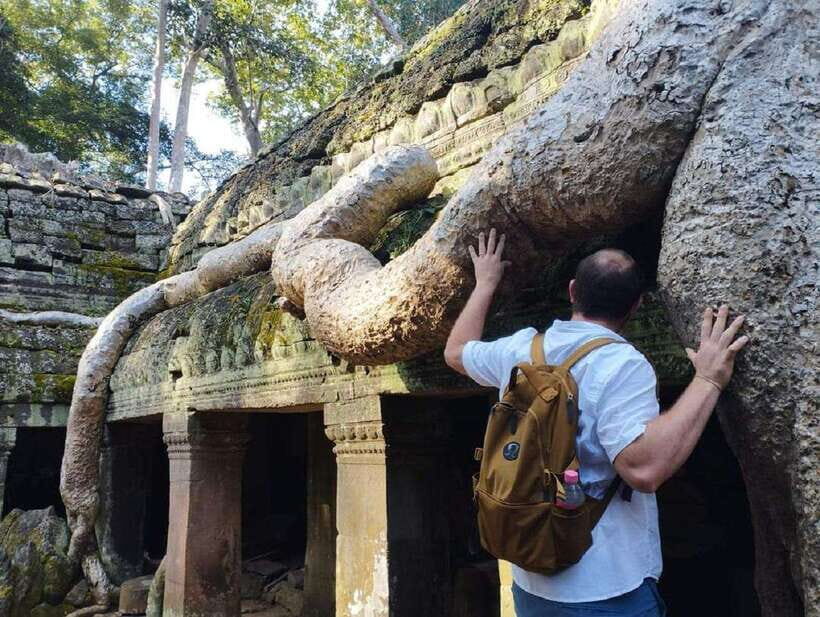
Ta Prohm is the temple most people recognize from photos. Giant banyan and kapok trees spread roots across stones. The trunks twist among pillars, and the branches can form a kind of roof over parts of the structure. It’s not a tidy, symmetrical place; it’s chaotic in the best way.
This is the stop where you benefit from having a guide who can point out what you’re actually seeing. The difference between a quick look and a meaningful one is often naming the features: where the trees are swallowing walls, how the stonework frames the roots, and what kind of ruin details you might otherwise miss.
This stop is also where you’ll feel the difference between a hot sunny hour and a cooler one. If you’re there when the sun is pounding, expect it. One comment tied to April heat was blunt: it’s super hot. So treat Ta Prohm like a place to pace yourself—shade when you can, water breaks when you need them.
One practical note from guide behavior: some guides bring extra help for the sun, like umbrellas for shade during visits. That’s not listed as a guaranteed item, but it’s a realistic “might happen” based on how guides operate on this route.
Angkor Wat in three hours: the biggest religious monument, paced for real viewing
Angkor Wat gets the time here—about three hours. That’s smart, because it’s not just one view. It’s layers: approach, courtyards, galleries, and the details that only show up once you’ve slowed down.
Why Angkor Wat is worth treating like a main event:
- It’s visually and artistically intense. The carvings—especially the Apsara figures—are everywhere you look once you start paying attention.
- The temple’s scale rewards pacing. If you sprint through, you miss the best bits.
A helpful detail: nearly 2,000 Apsara carvings adorn the walls, and the tour includes guidance on the most fascinating temple parts and the largest religious monument on earth. So you’re not just wandering—your route is shaped to help you see the best of what Angkor Wat has to offer without feeling lost.
What can feel challenging: Angkor Wat is popular and busy. You’ll walk, you’ll climb some steps, and you’ll deal with crowds at the most photographed spots. On a half-day schedule, you’ll likely move efficiently from highlight to highlight rather than spending a full, slow day exploring everything at your own speed.
Price and value: what $28 per group really buys you
The headline price here is $28 per group (up to 3 people). That’s often the difference between making Angkor happen or postponing it.
Here’s how I’d think about value:
- You’re paying for pickup/drop-off, transport, and the on-site timing across three temples.
- You’re also getting comfort extras: mineral water, cool towel, and air-conditioned vehicle.
- The tour also works as a private arrangement for your group size, which reduces the usual headaches of shared scheduling.
What’s not included is the big cost item you shouldn’t forget: admission fees via the Angkor Pass and temple tickets. Food and drinks aren’t included either. And the professional English-speaking tour guide isn’t included in the base package listing.
So the honest equation is this: the $28 price buys you the logistics and comfort, not every component of a full guided day. If you want deep explanations at each site, you may need to add that separately depending on your setup. The good news is that many guides operating this route are praised for clear English explanations and helping with questions. Examples of guide names tied to strong experiences include Thy, Vandy, and Moeun (who goes by John).
Bottom line: if you’re comfortable paying admission separately and you like moving efficiently, this is strong value.
Getting the timing right: morning vs afternoon departures
You can choose morning or afternoon. That matters in Siem Reap and at Angkor, because the light and heat can change your experience fast.
Morning tends to mean:
- cooler walking conditions
- fewer crowds at some of the easiest-to-photograph angles
Afternoon tends to mean:
- longer daylight hours for photos
- the possibility of hotter conditions, especially in peak months
Either way, the route is designed to connect nearby temples so you don’t waste time. That’s why this half-day format works: you’re not spending your limited temple time parked in traffic.
What the guide and driver do for you on a short day
Even when the guide component isn’t included in the base price, the overall experience depends on how well your team runs the timing and transitions.
In practice, strong guides on this route do a few repeat jobs:
- They explain what you’re looking at in plain language, including history and architecture.
- They answer questions without making you feel rushed.
- They keep the pace moving so you don’t linger too long at one site and short-change the next.
Names that show up in examples of great service include guide Thy and guide Vandy, with driver Chet also mentioned in connection with a smooth day. Another guide, Mr. Kuhn, was praised for fluency in English and for knowing Cambodia in general, not just the stones in front of you.
And photo help matters more than people think. One experience noted that the guide was good at taking iPhone photos while timing you through the best angles. If you’re traveling as a pair or family, that kind of small help can save you from awkward self-timer attempts.
Who should book this half-day Angkor Wat, Ta Prohm, and Bayon tour
This tour fits best if:
- you want Angkor’s highlights without committing a full day
- you’re on a tight schedule in Siem Reap
- you prefer a set route with transportation handled
- you like the idea of comfort touches like cool towels and cold water
It might not fit as well if:
- you want to wander slowly with no time pressure
- you plan to spend lots of time just sitting and sketching
- you’re sensitive to heat and dislike walking even short distances
If your priority is value plus efficiency, it’s a solid match. If your priority is depth at every corner, you might eventually want a longer guided day too.
Should you book it?
Yes, if you want an efficient Angkor hit. I’d book it when you’re short on time, because the structure makes it hard to fail: you see Bayon’s faces, Ta Prohm’s iconic trees, and Angkor Wat with enough time to actually notice details.
I’d also book it if the comforts matter to you. Cold water, cool towels, and air-conditioned driving keep the day from turning into a slog.
Just budget for the Angkor Pass and admission fees. Then you’ll go in with no surprises.
FAQ
How long is the tour?
The tour runs about 5 hours (approx.), with scheduled time at each temple.
Does the tour include hotel pickup and drop-off?
Yes. Hotel pickup and drop-off are included.
What’s included in the price?
You get hotel pickup/drop-off, mineral water and a cool towel, air-conditioned vehicle transport, and private transportation.
Are Angkor Pass and admission fees included?
No. Admission fees and the Angkor Pass are not included.
Is food included?
No. Food and drinks are not included.
Is an English-speaking tour guide included?
No. A professional English-speaking tour guide is listed as not included.
Is this tour private?
Yes. It’s private, and only your group participates.
Can I choose a morning or afternoon departure?
Yes. Morning and afternoon departures are available.
Can I cancel for a full refund?
Yes. You can cancel up to 24 hours in advance for a full refund, based on local time.