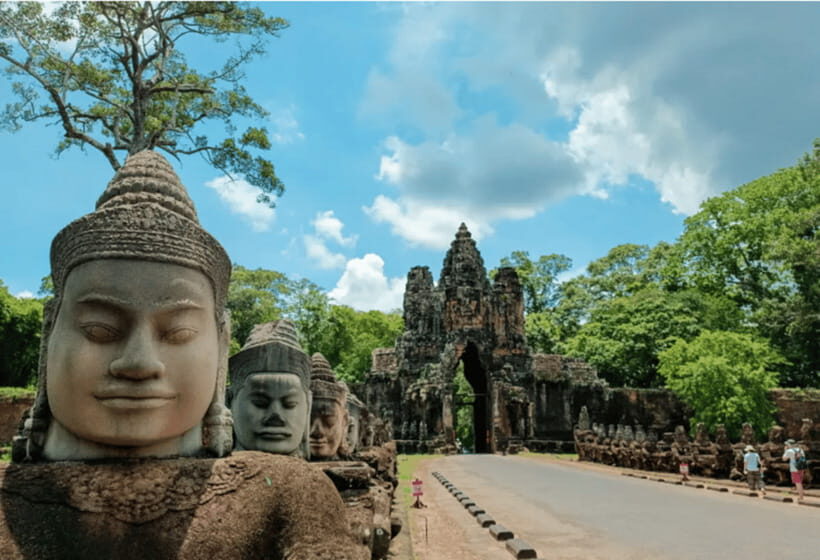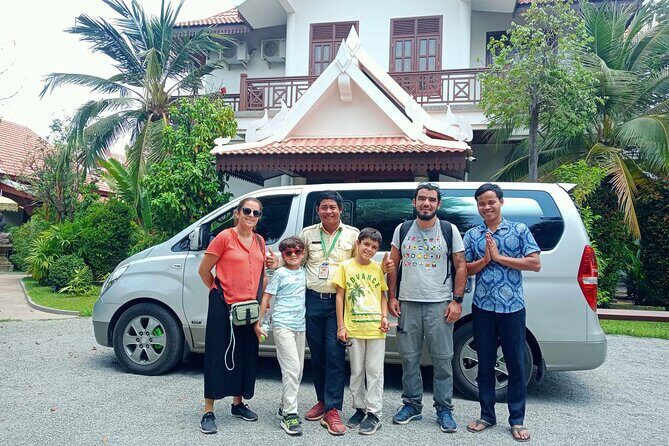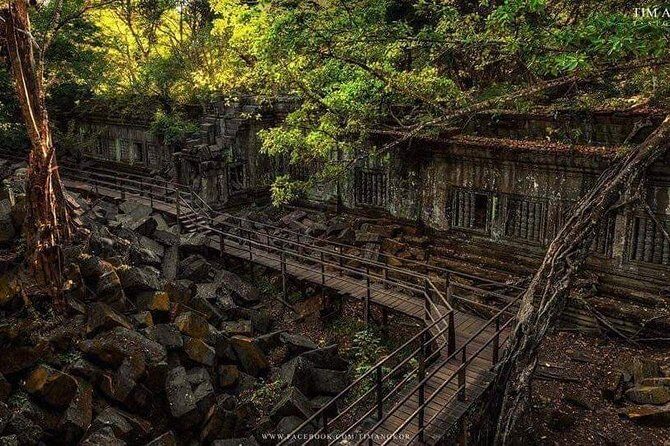
Phnom Kulen mixes temple mystique with a real hike. This full-day tour from Siem Reap takes you up to the mountaintop reclining Buddha statue, explains why it matters to the Linga Cult, then rolls into nature at Kulen Mountain and Kulen Waterfall.
I love that the day isn’t just scenic stops. You also get context for what you’re seeing—like the carved symbols at the 1000 Lingas site—plus a chance to meet people and hear stories from guides such as Mr Lux or Cherry. One thing to keep in mind: the timing is tight, and entrance fees aren’t included, with a long drive that can feel like a lot for a short waterfall visit.
In This Review
- Key things to know before you go
- Phnom Kulen from Siem Reap: sacred peak meets wet stone
- The ride and timing: how 6 hours can still feel full
- Stop 1: Phnom Kulen National Park and that first walk
- Stop 2: the 1000 Lingas site and what to look for
- Stop 3: reclining Buddha and the mountaintop moment
- Stop 3.5: Kulen Waterfall—worth the shoes and the sweat
- Stop 4: palm sugar factory and local market taste test
- Stop 5: Preah Dak and rural-life glimpses (and the Beng Melea connection)
- Price and value: what $78 buys (and what it doesn’t)
- The guide can make or break the day
- Watch-outs: who should adjust expectations
- Should you book Phnom Kulen National Park from Siem Reap?
- FAQ
- How long is the Phnom Kulen National Park tour?
- Does the price include entrance fees to Phnom Kulen?
- What’s included in the tour price?
- Is hotel pickup offered from Siem Reap?
- What are the main stops during the day?
- What cancellation options are available?
Key things to know before you go
- Reclining Buddha up top: a mountaintop stop that’s more than a photo moment, especially if your guide explains the religious meaning.
- 1000 Lingas (Kbal Spean-style area): you’ll see Shiva-linked carvings in a river-bed setting—bring your curiosity, not just your camera.
- Kulen Waterfall has the best payoff: the hike can be slippery, so plan for careful footing and possible splash time.
- Palm sugar factory + local market stop: a short but genuinely Cambodian add-on where you can taste what’s made nearby.
- Small group size (max 15): easier questions, less waiting around, and a smoother day.
- No entrance fees included: budget extra for park access and any paid sections on the route.
Phnom Kulen from Siem Reap: sacred peak meets wet stone
If you like your Cambodian days to have both meaning and movement, Phnom Kulen is a strong pick. You’re starting from Siem Reap, then heading into the Phnom Kulen mountain massif—part temple pilgrimage, part nature escape. The day is built around three big ideas: a sacred mountaintop, a stone-carved religious landscape, and a waterfall you can actually feel.
The best part is that the tour doesn’t treat the spiritual stops as random ruins. You’re told what to look for and why it was made. For example, the reclining Buddha statue on the mountaintop connects to local traditions tied to the Linga Cult. And at the 1000 Lingas site, you’ll see carved lingas dedicated to Shiva—symbols that can look like decoration until someone explains what they represent.
And yes, the day also has a practical side. You’ll get hotel pickup and drop-off, a/c transport, and mineral water. For $78, that’s a lot of logistics handled for you—especially if you’d rather not negotiate a driver for a multi-stop route.
The ride and timing: how 6 hours can still feel full
This is a full-day tour with an approximate 6-hour duration. The exact rhythm depends on traffic and the pace of your group, but the structure is consistent:
- You’ll spend about 2 hours at Phnom Kulen National Park as your base time.
- Then you’ll move to 1000 Lingas for roughly 30 minutes.
- You’ll get another 30 minutes at Phnom Kulen Waterfall.
- On the way back, there’s time for a local market and palm sugar factory stop (about 40 minutes).
- There’s also a short Preah Dak stop (about 30 minutes), with a chance to experience rural life and see connections to Beng Melea mentioned in the route description.
Here’s the reality check: you’re not going to linger forever at every site. You’re visiting a lot of stops in a single day, so you’ll want to come ready to “go with the flow.” The waterfall is the moment that tends to win people over most, but you still only get a chunk of time there.
Also, factor in drive time. One review-style concern you should take seriously: the road can add up—expect at least about 90 minutes one way in worst-case timing. That doesn’t make the trip automatically bad, but it does mean you shouldn’t plan the day like it’s a 30-minute hop.
Stop 1: Phnom Kulen National Park and that first walk
Your biggest early block is Phnom Kulen National Park itself, with about 2 hours on the clock. Since entrance fees aren’t included, you’ll need to plan for paid access when you arrive.
This part of the day matters because it sets your expectations. You’re not just driving through; you’re getting time in the park area where the temples and viewpoints sit in the mountain setting. Think of it as your “soak it in” phase—time to take in views, get bearings, and start understanding the spiritual geography before you hit the carved sites and water.
If you’re the type who likes photos, this is where you’ll collect them. If you’re more into explanations, this is where your guide can connect the dots: why the area is considered sacred, and how the later stops fit into that story.
Stop 2: the 1000 Lingas site and what to look for
The 1000 Lingas stop is short—around 30 minutes—but it’s the kind of stop that can either click fast or feel confusing if you don’t know what you’re seeing.
Lingas are symbols associated with Shiva. At this site, you’ll find many carved lingas in what’s often described as a valley or river-bed setting. The carvings matter because they’re part of a religious tribute, not random decoration.
Here’s my practical advice: don’t treat this as just a quick sightseeing stamp. Ask your guide to point out the meaning of the carvings as you walk. If you don’t understand what the symbols represent, the site can feel like stone details without context.
Guides really do affect this stop. In past experiences with this kind of tour, guides like Mr Lux have been singled out for answering questions about Cambodia’s mountain and history, and that kind of back-and-forth can make a short stop feel longer.
Stop 3: reclining Buddha and the mountaintop moment
This is one of the day’s centerpiece attractions: the mountaintop reclining Buddha statue at Preah Ang Thom area (the tour description frames it as 16th-century and tied to Linga Cult tradition).
Even if you only have a bit of time at each site, the mountaintop stop carries weight because it combines:
- a dramatic setting,
- a clear visual focal point,
- and a story you can actually understand if your guide shares the significance.
What to do with your time here: look for the overall composition first (how the statue sits in the scene), then listen for the religious connection. If your guide mentions the Linga Cult tie-in, it helps explain why the day also includes the lingas. It’s not separate sightseeing—it’s one connected theme.
If you get a guide like Cherry, expect a friendly, info-forward pace. In at least one case, she was described as both informative and welcoming, and that kind of guide energy can make the mountaintop feel less rushed.
Stop 3.5: Kulen Waterfall—worth the shoes and the sweat
If you want the one stop that most often makes people say the day was worth it, it’s Kulen Waterfall. You’ll get about 30 minutes there, which is short—but the payoff can still be big because the waterfall creates a sensory break from temples and stone carvings.
Practical reality: the path can be rough. One key warning is about uneven surfaces and large rocks, some of which can be slippery. So wear shoes with grip. If you go in sandals, you’re asking for trouble.
Also, if you’re in for the fun part—water contact—bring the stuff that makes it comfortable. One smart tip from past experience: pack a towel and swimwear. Even if you don’t plan to swim, having the option keeps you from worrying about getting soaked and stuck.
Finally, be ready for a quick window. The waterfall time is not a long beach afternoon. It’s a hike-in, splash-where-you-can, and move-on kind of stop.
Stop 4: palm sugar factory and local market taste test
On the way back, you’ll get a local market and palm sugar factory stop (about 40 minutes). This is the most “normal life” feeling part of the day, and it’s also where you can slow down a bit.
What makes it worth it is the tasting angle. The tour description explicitly calls out that you can taste palm sugar with locals. That’s small, but it’s the kind of detail that turns a day trip into something you’ll remember.
This stop also helps break up the drive back. You’re not only exiting the mountain; you’re sampling what people near the route actually produce.
Stop 5: Preah Dak and rural-life glimpses (and the Beng Melea connection)
There’s a final shorter stop called Preah Dak (about 30 minutes). The route description frames it as a chance to experience rural life, and it also mentions Beng Melea in the overall tour description.
Since the itinerary time here is brief, treat it as a context stop rather than a full temple session. This is a good moment for quick questions:
- What’s the role of this area in daily life?
- How do people make use of the land away from big tourist circuits?
If you’re hoping for a big standalone temple visit here, don’t plan on it. This is more about adding local texture to the day.
Price and value: what $78 buys (and what it doesn’t)
At $78 for about a half-day-to-full-day outing, the value comes from what’s included:
- Hotel pickup and drop-off
- Round-trip transportation in an a/c vehicle
- Licensed English or Japanese-speaking guide
- Mineral water
- A capped group size (max 15 travelers)
What’s not included is also important for budgeting:
- Entrance fees for Phnom Kulen
- Food and drinks unless specified
- Tips
One more value note: the tour structure is designed to cover several highlights in one day without you arranging separate rides. If you’ve ever tried to piece together a multi-stop temple-and-nature day from Siem Reap, you know how quickly costs and timing can balloon.
So is it worth $78? For most people who want a balanced day—temples plus a waterfall hike—yes. For people who only care about the waterfall and dislike long drives, you might feel the day moves too fast for the travel effort.
The guide can make or break the day
Two guide names show up as standout examples: Mr Lux and Cherry. That’s useful because it points to the kind of tour experience you’re likely to get—at least with some guide pairings.
What you want to ask when you meet your guide:
- What do the 1000 Lingas represent?
- Why is the reclining Buddha connected to the Linga Cult?
- What’s the safest route on the waterfall path?
When guides handle the “what am I looking at?” side well, the entire day makes more sense, even if your stop times are short.
Watch-outs: who should adjust expectations
I don’t sugarcoat this. There’s one big theme in a negative take: some people felt the experience wasn’t worth the effort, largely because the drive is long and some stops didn’t feel as impressive as expected.
Here are the realistic considerations you should plan around:
- Drive time is real. If you hate time-on-road, this might feel like a chore.
- Waterfall time is limited. You’ll enjoy it most if you’re fine with a short hike-in and a brief splash.
- Some stops can feel transactional. At certain locations, you may run into informal requests for money tied to the area. Keep a small amount ready, stay polite, and decide calmly what you want to support.
If you keep these in mind, the day usually lands better.
Should you book Phnom Kulen National Park from Siem Reap?
Book it if you want:
- a temple-plus-nature day,
- a guide who can explain the meaning behind what you see,
- and the Kulen Waterfall experience without planning transport yourself.
Skip it or choose something else if:
- you only want a quick, low-effort trip,
- you’re sensitive to slippery hiking and short stop times,
- or you get annoyed by long drives that don’t feel proportional to the time at each site.
One final practical note: this tour offers free cancellation up to 24 hours in advance (so you can hold your spot while you finalize other Siem Reap plans).
FAQ
How long is the Phnom Kulen National Park tour?
It’s listed as approximately 6 hours.
Does the price include entrance fees to Phnom Kulen?
No. Entrance fees for Phnom Kulen are not included.
What’s included in the tour price?
Hotel pickup and drop-off, transportation in an a/c van or bus, a licensed English or Japanese-speaking guide, mineral water, and the guided stops. Food and drinks are not included unless specified.
Is hotel pickup offered from Siem Reap?
Yes, hotel pickup and drop-off are included.
What are the main stops during the day?
You’ll visit Phnom Kulen National Park, the 1000 Lingas area, Phnom Kulen Waterfall, a local market and palm sugar factory on the way back, and a short stop called Preah Dak.
What cancellation options are available?
You can cancel for a full refund up to 24 hours in advance of the experience start time.